Research Article | | Peer-Reviewed

Capital Flight and Growth of Nigeria’s Economy (1980-2023): An Autoregressive Distributed Lag (ARDL) Modelling

Published in Economics (Volume 15, Issue 2)
Received: 30 October 2025     Accepted: 14 November 2025     Published: 23 April 2026
Views:       Downloads:
Abstract

This study investigated the impact of capital flight on Nigeria’s economic growth from 1980 to 2023. Preliminary analyses, revealed that variables were stationary at level and first difference, I(0) and I(1), respectively. Given the data characteristics, the Autoregressive Distributed Lag (ARDL) bounds testing approach to cointegration was applied. The results from the ARDL model confirmed a significant long-run relationship between capital flight and economic growth, indicating an inverse relationship in both the short and long run. Specifically, external debt exerted a negative effect on growth in the short run (-0.94) but turned positive in the long run (-0.86). Insecurity, with coefficients (-1.06) and (-4.76), had a consistently negative and statistically significant impact on economic growth in both the short and long run. Similarly, the exchange rate negatively influenced growth in the short run (-0.02) but showed a positive long-run relationship (0.002). The current account balance, on the other hand, had a positive effect on economic growth in both the short run (0.0024) and the long run (0.0003). The Error Correction Model (ECM) reparameterization of the ARDL framework indicated a speed of adjustment of 95%, which was statistically significant and correctly signed, suggesting a strong tendency toward long-run equilibrium. Based on these findings, the study recommends that the Federal Government of Nigeria adopt comprehensive measures to curb the drivers of capital flight—such as macroeconomic instability, institutional weaknesses, and external incentives—through sound economic policies, political stability, and institutional strengthening. Furthermore, the government should intensify efforts to combat insecurity by equipping security agencies with modern technology and incentives, ensuring effective protection of lives, property, and the overall social, political, and economic development of the nation.

Published in Economics (Volume 15, Issue 2)
DOI 10.11648/j.eco.20261502.11
Page(s) 29-40
Creative Commons

This is an Open Access article, distributed under the terms of the Creative Commons Attribution 4.0 International License (http://creativecommons.org/licenses/by/4.0/), which permits unrestricted use, distribution and reproduction in any medium or format, provided the original work is properly cited.

Copyright

Copyright © The Author(s), 2026. Published by Science Publishing Group

Keywords

Capital Flight, Current Account Balance, Economic Growth, Exchange Rate, External Debt, ARDL Model and Insecurity

1. Introduction
For several decades, the phenomenon of capital flight from developing nations, including Nigeria, has attracted significant scholarly attention, notably from researchers such as . Numerous scholars have expressed profound concerns regarding the magnitude, origins, and implications of capital outflows from developing economies. These apprehensions stem largely from the chronic inadequacy of financial resources required to sustain meaningful economic development, which has compelled many Sub-Saharan African nations, including Nigeria, to resort to external borrowing as a means of supplementing domestic capital in their pursuit of economic growth. A central constraint to Nigeria’s economic advancement remains the persistent scarcity of financial resources, compounded by ineffective governance and the mismanagement of available assets. Currently, the country faces widening fiscal and financing deficits that continue to undermine both private and public investment, generate macroeconomic instability, and deepen economic stagnation.
Against this backdrop, the Nigerian government has become increasingly indebted to international financial institutions in an attempt to bridge the prevailing resource gap. The concept of capital flight generally refers to the large-scale transfer of financial assets from one economy to another, typically motivated by the desire to avoid country-specific risks—such as inflation, political instability, or exchange rate volatility—or to secure higher returns on investment elsewhere . The scale, persistence, and structural nature of capital outflows from Nigeria indicate that their underlying determinants extend beyond purely economic variables, encompassing significant political dimensions and the interplay between political decision-making and the broader economic environment.
The Nigeria economy political unpredictability, insecurity, bad leadership, labor conflict, mis-management of fund and corruption have amplified the strength of capital flight with the 1985 military coup incidence, which conveyed General Ibrahim Babangida to power, 1987 coup, and 1991 bade coup against President Babangida etc. Though, Nigeria capital flight became further noticeable between 1976 and 1991 the periods it books for an average of about 7.4 percent of the GDP (Gross Domestic Product), and the movement has been aggravating since . Between 1981 and 1990, the trend increased by over 511.17 percent as match to the economic growth of only 30.89 percent within the observed period. Also, within 1990 and 1999, the proportion increased, where capital flight and economic growth were estimated at 1,825.57 percent and 19.63 percent respectively, Then between 1999 and 2007, the increase rate in capital flight tended to be on decrease, as it increase by just 268.70 percent compare to previous decade, while the economy gross domestic product also grew by 61.34 percent relative to the earlier decade .
Meanwhile, between 1992 and 1993, Nigeria experienced an increase in the exchange rate from ₦17.30 to ₦22.07 per US dollar, accompanied by a rise in capital flight from US$2,346 million to US$3,307 million, while GDP expanded from US$337.29 million to US$342.54 million—signifying an upturn in economic activity during the period. However, throughout much of the 1990s, the country was characterized by persistent incidences of capital flight. Specifically, capital outflows were recorded at US$103 million in 1990, US$2,346 million in 1992, US$3,307 million in 1993, US$1,405 million in 1994, US$1,496 million in 1997, and US$3,337 million in 1999 .
Using the residual method of measuring capital flight, negative values denote net capital inflows or reversals, while positive figures indicate outflows. Periods such as 1988, 1991, 1995, 1996, 1998, 2001, and 2004 recorded negative capital flight values of –US$149 million, –US$3,680 million, –US$2,576 million, –US$3,484 million, –US$5 million, and –US$1,508 million respectively, suggesting capital reversals during these years . Such reversals are typically linked to reduced or abrupt halts in foreign direct investment inflows, often resulting from unfavorable domestic conditions such as political instability and economic downturns. These conditions discourage foreign investment, trigger liquidity challenges, and compel the government to utilize foreign exchange reserves for debt servicing—thereby exacerbating currency depreciation, inflation, and recessionary pressures .
Conversely, the years showing positive capital flight values—such as 1986, 1987, 1989, 1990, 1993, 1994, 1997, 2000, 2002, 2003, 2005, 2007, 2008, 2009, 2010, 2011, 2012, 2013, 2014, and 2015—reflect substantial outflows of domestic capital to foreign economies, with corresponding figures ranging from US$372 million to US$7,065 million. Notably, the period between 2016 and 2018 witnessed an unprecedented outflow totaling approximately US$53.935 billion, largely attributed to increased external investments by Nigerian investors seeking higher returns abroad and illicit capital transfers by corrupt public officials. These developments considerably diminished investible capital within the domestic economy .
Furthermore, a marked decline in capital flight occurred between 2014 and 2015, dropping from US$7,065 million to US$1,675 million, alongside an increase in GDP from US$67,152.79 million to US$69,780.69 million . This pattern suggests notable economic improvement and a reduction in capital outflows during the period. The improvement may be linked to the anti-corruption initiatives of the administration of former President Muhammadu Buhari, which focused on curtailing illicit financial outflows and facilitating the repatriation of stolen public funds to support domestic economic growth and development .
Over the years, concerns about the rising incidence of capital flight in Nigeria and its implications for economic growth have continued to intensify, prompting several research investigations into the issue. Capital outflow occurs when financial resources exit the country, leading to potential losses in economic sustainability. This situation is particularly critical for economies that rely heavily on external financing, such as international aid and support, to sustain development efforts .
Presently, attention is being diverted in the direction of an oil based mono-cultural economy making it more challenging. Thus, irrespective of numerous government efforts towards embracing foreign capital inflows, the impacts of these inflows towards economic revolution precisely and economic growth in general is still hindered and/or mired. The primary aim of macroeconomic policy is to enhance the overall performance of the economy. Consequently, achieving and sustaining key objectives such as a reasonable level of employment, efficient resource utilization, a stable balance of payments, equitable income distribution, price stability, and continuous economic growth remain central to macroeconomic management. Among these objectives, sustainable economic growth stands out as the one most directly influencing the standard of living of individuals . Despite the importance of this issue, limited scholarly attention has been devoted to it, thereby underscoring the author’s interest and the necessity of this study.
Based on the above discretion, the research is to disparagingly examine the determinants of capital flight as major objective and its impact on economic growth of Nigeria. Specifically, the other objectives include:
i. To determine the significant relationship between capital flight and Nigeria’s economic growth.
ii. To assess the impact of external debt servicing on the growth performance of Nigeria’s economy.
iii. To analyze the influence of insecurity on Nigeria’s Gross Domestic Product (GDP).
iv. To investigate how fluctuations in the exchange rate affect Nigeria’s Gross Domestic Product (GDP).
v. To evaluate the effect of current account balance on the overall growth of Nigeria’s economy.
2. Literature Review
This section centers on relevant literatures that were deduced from different scholars appraising capital flight and impact on growth of economy to find the research gaps and to fill them appropriately. The section was sub-divided into three reviews, that is, conceptual, theoretical and empirical review.
2.1. Conceptual Review
2.1.1. Concept of Capital Flight
Bonilla describes capital flight as the transfer of funds and investments from a domestic economy to foreign destinations perceived as safer and more profitable. The underlying motivation, according to him, is often to conceal assets from regulatory or governmental authorities . Schneider defines capital flight as the portion of resident capital outflows primarily induced by economic and political insecurity . In a similar view, Mahon considers capital flight as a mechanism through which individuals protect their savings from exploitation by corrupt or unstable political regimes .
Otene further describes capital flight as the large-scale relocation of financial resources between countries, typically to avoid political or economic turbulence or to pursue higher returns on investment. The illegal movement of capital across borders, therefore, implies that such transfers can be either authorized (legal) or unauthorized (illegal). In this context, abnormal capital flows refer to movements that are not sanctioned by the government .
According to Adekunle, capital flight involves the transfer of funds from domestic investments to foreign assets as a response to country-specific risks such as hyperinflation, political instability, or the expected depreciation of the domestic currency, or in pursuit of greater profitability abroad. Capital flight is recognized as a critical factor that exacerbates external debt burdens and impedes developmental progress in developing countries . Furthermore, persistent capital outflows aggravate the international financial challenges of heavily indebted poor nations, as institutions such as the International Monetary Fund (IMF) and other external financiers may become hesitant to extend further assistance due to the erosion of confidence in the domestic economy .
Accordingly, this study investigates the impact of capital flight on Nigeria’s economic growth, viewing it as both legal and illegal transfers of capital and resources from the domestic economy to foreign destinations, primarily motivated by political and economic uncertainties.
2.1.2. Concept of Economic Growth
Economic growth refers to the sustained increase in the market value of goods and services produced by an economy over time and is conventionally measured as the percentage change in real gross domestic product (GDP). Todaro and Smith define economic growth as a long-term process through which the productive capacity of an economy expands, resulting in rising levels of output and income . Amos and Obansa interprets economic development as the continuous improvement in the living conditions of a country’s population, deriving from an enhanced ability of the people to solve social and economic problems .
Todaro and Smith identify three fundamental components of economic growth: capital accumulation, population growth, and technological progress. Capital accumulation encompasses new investments in both physical and human capital through education, health, and skill development. The authors emphasize that investment in human resources can yield as significant, or even greater, productivity gains as investments in machinery, infrastructure, and equipment .
They also posit that population growth, accompanied by an expansion in the labor force, can stimulate economic performance by increasing productive capacity and broadening the domestic market—provided the economy can effectively absorb and utilize its workforce. Technological progress, the third major determinant, involves the adoption of new and improved methods of production that enhance efficiency across various sectors, including agriculture, industry, and services.
According to Todaro and Smith, technological progress can be classified into three types: labor-saving, neutral, and capital-saving. Neutral technological progress occurs when higher output levels are achieved using the same combination of input factors. Labor-saving innovations—such as automation, computerization, and mechanization—reduce dependence on manual labor, while capital-saving innovations, especially in developing economies, involve creating low-cost and efficient production techniques that conserve capital resources . In this study, economic growth is measured using Nigeria’s real gross domestic product growth rate (GDPGR). The use of real GDP, which accounts for inflation, enables accurate comparisons across time periods.
2.2. Theoretical Framework
This study was premised on theory of capital flight which was postulated by Cuddington and is categorized into two namely: The Investment Diversion and Debt-driven Capital Flight Theory . Therefore preferably, debt-driven theory is relevant to the study because it focused on the impact of capital outflow, diversion of investment and servicing of external borrowing on the growth of an economy which is focus of this study.
2.2.1. The Investment Diversion Theory
The investment diversion theory holds the view that due to macroeconomic and political uncertainty in developing countries and simultaneous existence of better investment opportunities in advanced countries like high foreign interest rates, wide array of financial instruments, political and economic stability and favourable tax climate, investors usually divert scarce capital resources to advanced countries. The notion of this theory is that owing to the macroeconomic and political uncertainty in emerging nations and the simultaneous presence of better investment opportunities in developed countries i.e. high foreign interest rate, vast range of financial instruments, favourable tax climate, political and economic stability and secrecy of accounts. Some, corrupt, fraudulent leaders and bureaucrats usually cart away with scarce capital resources from their nations to advanced countries. These funds are thus, not accessible for investment in their nation’s leading to a decrease in aggregate investment, low economic boom, therefore declining the employment, increase in dependency ratio and high mortality rate. This stirs up the need for countries affected by these negative macroeconomic effects to borrow from abroad to service the domestic economy, which occasionally is still siphon thus prompting external dependency and indebtedness. Ajayi expressed that depreciation of domestic currency may arise owing to the liquidity constraint or crowding-out effect if the authorities are operating a floating exchange rate system. The exchange rate if attempted to be defended at this time would result to a loss of international reserves . The investment diversion thesis offers one of the renowned negative consequences of capital flight in the countries in concern .
2.2.2. Debt-driven Capital Flight Theory
This theory is also known as debt-overhang theory which states that capital flight reduces the encouragement to save and invest. The assumption is that; with large foreign debt, there is the expectation of exchange rate devaluation, fiscal crisis, and the propensity of expropriation of assets to pay for the debt. Capital flight leads to poor growth, which calls for the necessity to borrow from abroad. Further borrowing or indebtedness promotes capital flight, which in turn, leads to poor economic growth, and the cycle continues and .
The theory also believed that there is a loss of prospective income due to capital flight for the fact that the domestic administration could not control and tax the wealth held in oversea. This government revenue reduction makes the task of politico-economic business in promoting growth and development more worrisosme and problematic. Invariably, it will bring the government a decrease in their debt-servicing ability and as a result, the debt burden will rise and have pressures on trade and industry advancement. Consequently, capital flight openly shows a reduction in the government income creating potential.
2.3. Empirical Review
Several studies have examined the relationship between capital flight and economic growth in Nigeria, employing different methodologies and timeframes. For instance, Oladimeji, Adebayo and Ohiaeri analyzed the impact of capital flight on Nigeria’s economic growth between 1980 and 2019, using annual time series data and the Ordinary Least Squares (OLS) estimation technique. The study found that capital flight exerted a significant negative influence on economic growth (GDP), while gross capital formation (GCF) and foreign direct investment (FDI) positively affected growth. It concluded that capital flight, FDI, and GCF jointly exerted significant long-run effects on the Nigerian economy .
Similarly, Orji, Ogbuabor, Kama, and Anthony-Orji investigated the nexus between capital flight and economic growth in Nigeria for the period 1980–2017 using the Autoregressive Distributed Lag (ARDL) bounds testing approach. The findings revealed that capital flight significantly reduced economic growth in both the short and long run. Other determinants such as money supply, credit to the private sector, and domestic investment were also found to have significant impacts on economic growth . The study further highlighted Nigeria’s vulnerability to persistent capital outflows relative to other African nations.
Makwe and Oboro examined the effect of capital flight on Nigeria’s economic growth between 1990 and 2017. Employing co-integration analysis and Augmented Dickey-Fuller (ADF) tests for stationarity, the study adopted the OLS technique for estimation. The T-test results indicated a strong relationship between capital flight and GDP, suggesting that variations in capital flight significantly influenced economic growth .
Nelson, Krokeme, Markjarkson, and Timipere explored the relationship between capital flight and the real exchange rate in Nigeria from 1990 to 2014. Using unit root, co-integration, causality, and OLS tests, the study examined five independent variables—capital flight, FDI, current account balance, foreign borrowing, and external reserves—against the real exchange rate. Results showed a positive and significant relationship between foreign borrowing and the real exchange rate, while capital flight exhibited a negative but insignificant relationship .
Egbuwalo and Abere empirically analyzed the impact of capital flight on Nigeria’s economic growth using the World Bank residual approach to measure capital flight. Employing the ARDL model, the study established a long-run negative relationship between GDP and capital flight, indicating that rising capital outflows dampen long-term growth .
Lawal, Kazi, Adeoti, Osuma, Akinmulegun, and Ilo assessed the determinants and impact of capital flight on the Nigerian economy between 1981 and 2015 using the ARDL framework. Their model included current account balance, capital flight, FDI, foreign reserves, inflation, external debt, and real GDP. Findings confirmed a long-run relationship among the variables, with capital flight exerting a negative effect on economic growth .
Adedayo and Ayodele conducted an empirical investigation of the relationship between capital flight, GDP, and exchange rate from 1980 to 2014 using OLS and co-integration analysis. Their findings indicated a significant positive relationship among the variables, suggesting that capital flight influences macroeconomic stability through exchange rate fluctuations .
Kingsley and Eberechi studied the influence of capital flight on budget implementation in Nigeria for the period 1986–2014, using co-integration and vector error correction methods. The results established a long-run relationship between capital flight, government expenditure, external debt, government revenue, economic openness, and the real exchange rate. Notably, capital flight exhibited a positive and significant effect on government spending .
Olatunji and Oloye evaluated the impact of capital flight on economic growth between 1980 and 2012 using Johansen co-integration, OLS, and an error correction mechanism. Variables examined included capital flight, foreign reserves, external debt, FDI, current account balance, and GDP. The results revealed that capital flight negatively influenced economic growth, consistent with prior empirical findings .
Saheed and Ayodeji explored the effects of capital flight on exchange rate and economic growth using OLS analysis of secondary data from the Central Bank of Nigeria and the National Bureau of Statistics. Their findings diverged from most prior studies, showing a positive and statistically significant relationship between capital flight and both exchange rate and economic growth .
Lastly, Uguru investigated the effect of capital flight on the performance of selected multinational corporations in Nigeria using OLS regression. The findings showed that profit repatriation, transfer mispricing, and over-invoicing increased production costs and consumer prices, while tax evasion through capital flight reduced government revenue .
Collectively, the reviewed studies underscore a consistent pattern: capital flight tends to impede Nigeria’s economic growth, especially in the long run, while other macroeconomic factors such as FDI, gross capital formation, and monetary variables can either mitigate or amplify its effects depending on the prevailing economic conditions.
3. Materials and Methods
The study employed an ex post facto research design and utilized the Ordinary Least Squares (OLS) estimation technique for data analysis. The methodological framework was adapted from Olatunji and Oloye, which is based on the World Bank residual approach, with certain modifications to suit the objectives of this study . According to Erdogdu and Cicek, an Autoregressive Distributed Lag (ARDL) Model is essentially an ordinary least squares framework that incorporates lagged values of both the dependent and explanatory variables among its regressors .
In the model, insecurity was incorporated as a dummy variable, where years characterized by stability and security were assigned a value of one (1), and periods marked by insecurity were assigned zero (0). The inclusion of the exchange rate variable aimed to capture the impact of government policy measures intended to curb capital outflows, which ultimately influence the nation’s economic growth. Meanwhile, the analysis was carried out within two months.
Accordingly, the model was specified in its implicit functional form as:
GDPGR = f(CAPFT, EXTD, INSCT, EXG, CAB) (1)
The implicit function in equation 1 could also be offered in a linear functional method as follows:
GDPGRt= β0+ β1CAPFTt+ β2EXTDt+ β3INSCTt+ β4EXGt+ β5CABt+ εt(2)
In order to linearize the variables the semi log-linear specification was expressed as:
GDPGRt= β0+ β1lnCAPFTt+ β2lnEXTDt+ β3INSCTt+ β4EXGt+ β5CABt+ εt(3)
Where:
GDPGRt = Gross Domestic Product Growth Rate
CAPFTt = Capital Flight
EXTDt = External Debt
INSCTt = Insecurity
EXGt = Exchange Rate
CABt = Current Account Balance
Ln = Log Linear
εt = Error term
β0 = Constant or intercept term
β1, β2, β3, β4, and β5, = Parameters to be estimated.
The equations above shows that the endogenous variable is GDPGR while independent are CAPT, EXTD, INSCT, EXG and CAB. The parameters of the respective functions are βi where i = 0,1,2,3,4 … n.
The short-run relationship model is specified in below:
∆GDPGRt0+i=1n1β1ilnCAPFTti=1n2β2ilnEXTDt+i=1n3β3iINSCTt+i=1n4β4iEXGt+i=1n5β5iCABt+ λECTt-1+ ε1t(4)
Conversely, for the long-run relationship model;
∆GDPGRt0+i=1n1β1ilnCAPFTt+i=1n2β2ilnEXTDt+i=1n3β3iINSCTt+i=1n4β4iEXGt+i=1n5β5iCABtε1t(5)
4. Results
4.1. Results Presentation
The analysis started with the descriptive statistics which shown below using E-Views 9.0, see appendixes.
4.2. Descriptive Statistics of Data
Table 1 shows the descriptive statistics and revealed that all variables exhibited moderate dispersion, indicating stable series suitable for regression analysis.
Table 1. Descriptive Statistics.

GDPGR

CAPFT

EXTD

INSCT

EXG

CAB

Mean

3.190055

2913.743

1958.245

0.227273

132.6170

-23.54864

Median

4.200375

2738.000

669.3250

0.000000

115.1250

2.980000

Maximum

15.32920

8285.000

9022.420

1.000000

647.2700

5178.000

Minimum

-13.12800

5.000000

1.980000

0.000000

0.550000

-7282.000

Std. Dev.

5.162448

2288.920

2336.525

0.423915

141.2430

2061.113

Skewness

-0.930955

0.628509

1.347102

1.301583

1.538603

-1.138488

Kurtosis

5.167793

2.443315

3.935964

2.694118

5.585196

8.331699

Jarque-Bera

14.97107

3.464988

14.91373

12.59506

29.61280

61.62133

Probability

0.000561

0.176843

0.000577

0.001841

0.000000

0.000000

Sum

140.3624

128204.7

86162.79

10.00000

5835.150

-1036.140

Sum Sq. Dev.

1145.987

2.25E+08

2.35E+08

7.727273

857832.4

1.83E+08

Observations

44

44

44

44

44

44

Source: Computed using E-view 9.0
4.3. Stationarity Result
The six variables (GDPGR, lnCAPFT, lnEXTD, INSCT, CAB, and EXG) went through unit root test using Augmented Dickey Fuller (ADF) and were all statistically significant at 1% level. The ADF test confirmed stationarity at mixed levels, justifying the ARDL approach.
Table 2. Unit Root Stationarity Results.

Variables

ADF Statistics

Critical Value

P-Value

Order of Integration

GDPGR

-3.7082

-3.6010 (1%)

-2.9350 (5%)

-2.6058 (10%)

0.0075

I(0)

lnCAPFT

-4.7976

-3.5922 (1%)

-2.9314 (5%)

-2.6039 (10%)

0.0003

I(0)

lnEXTD

-6.7348

-3.5966 (1%)

-2.9332 (5%)

-2.6049 (10%)

0.0000

I(1)

INSCT

-7.5032

-3.6105 (1%)

-2.9390 (5%)

-2.6079 (10%)

0.0000

I(1)

EXG

-5.2069

-3.6056 (1%)

-2.9369 (5%)

-2.6069 (10%)

0.0001

I(1)

CAB

-6.8283

-3.6394 (1%)

-2.9511 (5%)

-2.6143 (10%)

0.0000

I(1)

Source: Computed using E-view 9.0
Table 3. ARDL Bounds Test for Co-integration.

Null Hypothesis: No long-run relationships exist

Test Statistic

Value

k

F-statistic

5.514790

5

Critical Value Bounds

Significance

I0 Bound

I1 Bound

10%

2.26

3.35

5%

2.62

3.79

2.5%

2.96

4.18

1%

3.41

4.68

Source: Computed using E-view 9.0
Note:* indicates significant at 0.05 level (that is, F-Statistic>3.79 Critical Value)
The table above, shows the F-statistic is higher than the upper-bound critical value (3.79) at the 5% level. This suggests that the null hypothesis of no cointegration was rejected.
Table 4. ARDL Test Equation Analysis.

Variables

Coefficient

Standard Error

T-statistics

Prob.

C

28.98130

9.501482

3.050188

0.0086

∆LnCAPFT(-1)

-2.194874

0.454690

-4.827189

0.0003

∆LnEXTD

-0.935961

1.023351

-0.914605

0.3759

∆INSCT

-1.670313

1.313347

-1.271799

0.2242

∆EXG

-0.021745

0.013251

-1.641036

0.1231

∆CAB

0.002448

0.000636

3.848132

0.0018

ECMt-1

-0.950108

0.178550

-5.321255

0.0001

Model: Short-run Model Result
Source: Computed Using E-View 9.0
R2 = 0.882277
Adj. R2 = 0.67205
Standard Error Estimates = 2.132429
F-Statistics = 4.196915
Durbin Watson = 2.265145

Variables

Coefficient

Standard Error

T-statistics

Prob.

C

30.503176

9.188051

3.319875

0.0051

Ln(CAPFT)

-3.984864

1.018669

-3.911836

0.0016

Ln(EXTD)

0.857580

0.551711

1.554400

0.1424

INSCT

-4.761765

4.091616

-1.163786

0.2640

EXG

0.002413

0.010263

0.235130

0.8175

CAB

0.000310

0.000830

0.373818

0.7141

Model: Long-run Model Result
Source: Computed Using E-View 9.0
R2 = 0.920798
Adj. R2 = 0.77936
Standard Error Estimates = 2.132429
F-Statistics = 6.510538
Durbin Watson = 2.265145
The ARDL bounds test established a long-run relationship among capital flight, GDP, exchange rate, debt servicing, insecurity, and current account balance. The short-run coefficients showed that capital flight has a negative and statistically significant effect on GDP growth. This implies that the outflow of resources reduces domestic investment and savings, thereby lowering output. Showing that the long-run equilibrium is corrected in the current period at an adjustment speed of (0.950108) i.e. 95%, statistically significant and negatively signed. It shows the rate at which the economy is converging to equilibrium in the long-run. Exchange rate volatility was also found to negatively influence economic growth in the short run due to sustained demand for foreign currency and exchange rate misalignment. External debt servicing had an adverse effect on growth, suggesting that high repayment obligations crowd out funds for productive investment. Insecurity was found to have a negative but statistically insignificant effect on GDP, reflecting its indirect impact through deterrence of investment activities. The long-run results corroborate the short-run findings: capital flight and external debt servicing exert persistent negative effects on economic growth, while external reserves promote it.
4.4. Trends Analysis
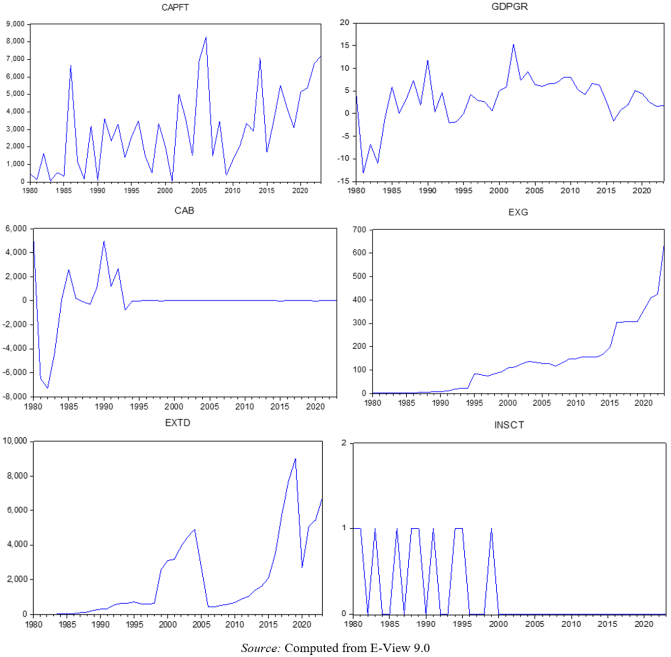
The trend analyses are shown below graphically:
Figure 1. Trends Analysis.
From the Figure 1 above, the macroeconomic indicators show an inconsistent trend except insecurity that takes the value of zero (0) since year 2000 till 2023. This was as a result of frequent insecurity in Nigeria in recent decades. There was upward and downward movement in respective year periods under review. These fluctuations could serve as a potential catalyst for capital outflow, driven by factors such as capital flight, political instability, inadequate infrastructure, rising external debt, exchange rate distortions, interest rate differentials, and unfavorable terms of trade that have characterized the country over the years. The observed pattern now exhibits irregular movements but tends to revert to its mean value, maintaining a relatively stable variance.
Table 5. Heteroscedasticity Test: Breusch-Pagan-Godfrey.

F-statistic

0.553264

Prob. F(25,14)

0.9046

Obs*R-squared

19.87898

Prob. Chi-Square(25)

0.7531

Scaled explained SS

1.794004

Prob. Chi-Square(25)

1.0000

Source: Computed Using E-View 9.0
From Table 5, considering the prob. Chi-Square values of 0.9 which was greater than 0.05 level, the decision is to reject the null hypothesis of no serial correlation in the model. Heteroscedasticity test shows that the variance of the analysis is constant over time with the F-probability of 0.8.
5. Discussion
The findings of this study indicate that capital flight exerts a negative and statistically significant influence on Nigeria’s Gross Domestic Product (GDP) growth rate in both the short and long run. This adverse effect stems from the erosion of domestic savings and investment levels caused by capital flight, which subsequently constrains national output. This outcome aligns with the work of Lawal, Kazi, Adeoti, Osuma, Akinmulegun, and Ilo, who employed the Autoregressive Distributed Lag (ARDL) model to examine the impact and determinants of capital flight in Nigeria, and similarly found that capital flight negatively affects economic growth . The result also corroborates the findings of Olatunji and Oloye, who investigated the relationship between capital flight and economic growth in Nigeria from 1980 to 2012 using Johansen co-integration, Ordinary Least Squares (OLS), and the Error Correction Mechanism (ECM). Their study revealed that capital flight, alongside variables such as foreign reserves, external debt, foreign direct investment, and current account balance, significantly influences GDP, with capital flight exerting a negative effect on economic growth .
Furthermore, this study found that external debt has a significant negative impact on economic growth in the short run but turns positive in the long run. This implies that, irrespective of the time frame, external borrowing influences Nigeria’s economic performance. However, the short-run negative effect suggests that rising external debt does not necessarily translate into economic expansion, possibly due to the mismanagement or unproductive use of borrowed funds. This observation is consistent with Sami and Mbah, who examined the nexus between government external borrowing and economic growth and reported a negative and significant association between the two variables .
The study also established that exchange rate fluctuations have a negative effect on economic growth in the short run. This outcome is attributed to the persistent demand for foreign currencies—particularly the U.S. dollar—which induces capital outflows, exerts pressure on the exchange rate, and consequently weakens the Nigerian naira. This result is in line with the findings of Attah-Obeng, Enu, Osei-Gyimah, and Opoku, who analyzed the relationship between GDP growth and exchange rate in Ghana from 1980 to 2012 and reported a similar negative short-run effect .
In addition, the study revealed that insecurity significantly undermines economic growth in both the short and long run. This finding corroborates the work of Rosenje and Adeniyi, who examined the effects of banditry on Nigeria’s security during the Fourth Republic, particularly in the North-West region. Their descriptive analysis showed that pervasive banditry hampers peace, stability, and regional development, driven by weak governance, high unemployment and poverty rates, porous borders, ineffective security frameworks, and the proliferation of small arms .
Finally, the study found that current account balance exhibit a positive relationship with Nigeria’s economic growth—statistically significant both in the short run and in the long run. Overall, the findings underscore that insecurity, capital flight, and exchange rate volatility have adverse and statistically significant effects on Nigeria’s economic growth in both time horizons.
6. Conclusions and Recommendations
6.1. Conclusion
The findings demonstrate that external debt has a negative and significant impact on Nigeria’s economic growth in both the short and long run. This suggests that increasing external borrowing does not contribute positively to economic growth. Similarly, capital flight was found to have a negative and significant relationship with GDP growth in both periods, indicating that the outflow of capital reduces domestic savings and investment, ultimately leading to a decline in national output. Moreover, exchange rate fluctuations were observed to negatively influence economic growth, though the effect was only significant in the short run.
6.2. Recommendations
The study recommended that for a capital flight reversal to transpire, there are steps to be taken by federal government to shun the causes (such as risks, financial sector constraints, external incentives, etc.) these steps involves promising economic guidelines, guaranteeing political firmness and established developments. In view of the fact that gross domestic product enhances and raises the level of external reserves position of a country, government is, therefore, anticipated to implement policies so that the level of gross domestic product growth in Nigeria will improve, so as to raise the level of the nation’s external reserves. Also, the federal government should sustain the efforts in prosecuting the war against the welfare of its people as well as equip the security forces with modern equipment and necessary incentives to enable them carry out their duty without hindrances. Federal government should provide adequate security to improve both food and human as well as its political and economic development.
Abbreviations

ARDL

Autoregressive Distributed Lag

CAPFT

Capital Flight

CAB

Current Account Balance

EXR

Exchange Rate

ECM

Error Correction Mechanism

FDI

Foreign Direct Investment

GCF

Gross Capital Formation

GDPGR

Gross Domestic Product Growth Rate

INSCT

Insecurity

IMF

International Monetary Fund

Ln

Log Linear

OLS

Ordinary Least Squares

Author Contributions
Oluwafemi Benjamin Adeyemi Amos: Writing – original draft
Sumaila Adavani Joseph Obansa: Supervision
Conflicts of Interest
The authors declare no conflicts of interest.
References
[1] Adedayo, O. C. & Ayodele, S. O. (2016). An empirical analysis of the impact of capital flight on Nigeria economy. International Journal of Academic Research in Economics and Management Sciences 5(2), 2226-3624.
[2] Adekunle, A. (2011). An economic analysis of capital flight from Nigeria. Policy Research Working Papers, Country Operations. World Bank WPS 993A.
[3] Ajayi, S. I. (2003). An analysis of external debt and capital flight in the severely indebted low income countries in Sub-Saharan Africa, Research Department, International Monetary Fund Working Paper 68 (Washington DC).
[4] Ajayi, S. I. (1995). Capital flight and external debt in Nigeria. African Economic Research Consortium (AERC) 10(1), 1-40. Research Paper 35.
[5] Ajayi, L. B. (2012). Capital flight and Nigeria economic growth. Asian Journal of Finance and Accounting, 4(2), 277-289.
[6] Alabi, O. R. & Ogboru, I. (2019). Effects of capital flight on exchange rate in Nigeria: 1986-2015. RAIS Journal for Social Sciences. 3(1), 15.
[7] Amos O. A. & Obansa, S. A. J. (2025): “The Effect of Foreign Direct Investment on the Growth of Nigeria Economy. (A Case of Manufacturing Sector: 1980-2023”). Being a Research article published from Journal of Economics, Innovative Management and Entrepreneurship on
[8] Asongu, S. (2014). Fighting African capital flight: Empirics on Benchmarking Policy Harmonization. JEL: C50; E62; F34; O19; O55.
[9] Attah-Obeng, P. En, P. Osei-Gyimah, F. & Opoku, C. D. K. (2013). An Econometric analysis of relationship between GDP growth rate and exchange rate in Ghana. Journal of Economics and Sustainable Development, 4(9).
[10] Bonilla, R. (2004). Macroeconomic Policy, Structural Adjustment and Debt Relief, International Development Research Centre (IDRC), Document 4.
[11] Busari, E. (2010). Capital flight and Nigeria’s economy. Journal of Economic Development, 10(2), 304-320. Retrieved from
[12] Cuddington, F. (1986). Capital flight: Estimates, issues and explanations. Princeton Studies International Finance. 58(2), 17-18. Retrieved from
[13] Erdoğdu H. and Çǐçek H. (2017). Modelling beef consumption in Turkey: the ARDL/bounds test approach. Turkish Journal of Veterinary and Animal Sciences. 41: 255-264. Retrieved from
[14] Egbuwalo, M. O. & Abere, B. O. (2018). Capital Flight and the Growth of Nigerian Economy: An Autoregressive Distributed Lag (ARDL) Modeling. IIARD International Journal of Economics and Business Management 4(2). Retrieved on from
[15] Kolapo, F. T., & Oke, M. O. (2012). Nigerian economic growth and capital flight determinants. Asian Journal of Business and Management Sciences, 1(11), 76-84.
[16] Kingsley, O. O. & Eberechi, B. N. (2016). Influence of capital flight on budget implementation in Nigeria. Scientific Paper Serves Management, Economic Engineering in Agriculture and Rural Development. 16(4), 247-256.
[17] Lawal, A. I., Kazi, P. K., Adeoti, O. J., Osuma, G. O. Akinmulegun, S. & Ilo, B. (2017). Capital flight and the economic growth: Evidence from Nigeria. Binus Business Review, 8(2), 125-132
[18] Mahon, J. E. (1996). Mobile capital and Latin America. Latin America Department. Pennsylvania University Press.
[19] Makwe, E. U. & Oboro, O. G. (2019). Capital flight and economic growth in Nigeria. International Journal of Business and Management Review 7(8), 47-76, Published by ECRTD-UK.
[20] Massa, I. (2014). Capital flight and the financial system. Working paper 413.
[21] National Bureau of Statistics, (2016). National economic construction fund. (NERFUND). Abuja: NBS.
[22] National Bureau of Statistics, (2020). Annual Abstract of Statistics. Abuja: NBS.
[23] Ndikumana, L. (2014). Savings, capital flight, and African development. Research in Economics and International Finance. Working Paper Series from Political Economy Research Institute, number 351. Retrieved from
[24] Nelson, J. Krokeme, O. Markjarkson, D. & Timipere, E. T. (2018). Impact of capital flight on exchange rate in Nigeria. International Journal of Academic Research in Accounting, Finance and Management Sciences, 8(1), 41–50, © 2018 HRMARS
[25] Ojonugwa, A. E. & Musa, L. P. (2019). Impact of real exchange on economic growth. DUTSE Journal of Economics and development Studies. 7(1), 22-31.
[26] Oladimeji, J. A., Adebayo, O. O., and Ohiaeri, N. V. (2022). The growth impact of capital flight in Nigeria. International Journal of Social Science and Economic Research. 7(3). 694-715.
[27] Olatunji, O. & Oloye, M. I. (2015). Impacts of capital flight on economic growth. International Journal for Innovation Education and Research, 3(8), 407. Retrieved from
[28] Olawale, O. & Ifedayo, O. M. (2015). Impacts of capital flight on economic growth in Nigeria. International Journal for Innovation Education and Research, 3(8), 12-25.
[29] Orji, A., Ogbuabor, J. E., Kama, K., and Anthony-Orji, O. I. (2020). Capital Flight and Economic Growth in Nigeria: A New Evidence from ARDL Approach. Asian Development Policy Review, 8(3), 171–184.
[30] Onyele, K. O. & Nwokocha, E. B. (2016a). The relationship between capital flight and poverty: The case of Nigeria. Scientific Papers Series Management, Economic Engineering in Agriculture and Rural Development, 16(3), 15-24.
[31] Otene, S. (2010). The impact of capital flight on economic growth in Nigeria. Department of Economics, University of Nigeria, Nssukka Published M.Sc. Thesis.
[32] Rosenje, M. O. & Adeniyi, O. P. (2022). The impact of banditry on Nigeria’s security in the fourth republic: An evaluation of Nigeria’s northwest. September, 2022. Retrieved 29th Dec., 2022 from
[33] Saheed, Z. S. & Ayodeji, S. (2012). Impact of capital flight on exchange rate and economic growth in Nigeria. International Journal of Humanities and Social Science 2(13), 247-255. Retrieved 20 August, 2021 from
[34] Sami, A. K. & Mbah, S. A. (2018). External debt and economic growth: a case of emerging economy. Journal of Economic Integration, 33(1), 1141-1157.
[35] Schneider, B. (2003). Measuring Capital Flight: Estimates and Interpretations. Overseas Development Institute Working Paper 194.
[36] Todaro, P. M. & Smith, C. S. (2009). Economic development. Pearson Education Limited Delhi 110092, India.
[37] Uguru, L. C. (2016). On the tax implications of capital flight: Evidence from Nigeria. Journal of Research in Economics and International Finance (JREIF) (ISSN: 2315-5671) 5(1), 001-007.
[38] Ugwuanyi, B. U. & Onyeka, V. N. (2012). Foreign exchange volatility and economic growth in Nigeria. ESUT Journal of Accountancy, 3(1), 118-124.
[39] World Bank (1985). Case study: Mexico. In Lessard D. R. and Williamson, J. (eds.). Capital Flight and Third World Debt. Washington D.C: Institute of International Economics.
Cite This Article
  • APA Style

    Amos, O. B. A., Obansa, S. A. J. (2026). Capital Flight and Growth of Nigeria’s Economy (1980-2023): An Autoregressive Distributed Lag (ARDL) Modelling. Economics, 15(2), 29-40. https://doi.org/10.11648/j.eco.20261502.11

    Copy | Download

    ACS Style

    Amos, O. B. A.; Obansa, S. A. J. Capital Flight and Growth of Nigeria’s Economy (1980-2023): An Autoregressive Distributed Lag (ARDL) Modelling. Economics. 2026, 15(2), 29-40. doi: 10.11648/j.eco.20261502.11

    Copy | Download

    AMA Style

    Amos OBA, Obansa SAJ. Capital Flight and Growth of Nigeria’s Economy (1980-2023): An Autoregressive Distributed Lag (ARDL) Modelling. Economics. 2026;15(2):29-40. doi: 10.11648/j.eco.20261502.11

    Copy | Download

  • @article{10.11648/j.eco.20261502.11,
      author = {Oluwafemi Benjamin Adeyemi Amos and Sumaila Adavani Joseph Obansa},
      title = {Capital Flight and Growth of Nigeria’s Economy (1980-2023): An Autoregressive Distributed Lag (ARDL) Modelling},
      journal = {Economics},
      volume = {15},
      number = {2},
      pages = {29-40},
      doi = {10.11648/j.eco.20261502.11},
      url = {https://doi.org/10.11648/j.eco.20261502.11},
      eprint = {https://article.sciencepublishinggroup.com/pdf/10.11648.j.eco.20261502.11},
      abstract = {This study investigated the impact of capital flight on Nigeria’s economic growth from 1980 to 2023. Preliminary analyses, revealed that variables were stationary at level and first difference, I(0) and I(1), respectively. Given the data characteristics, the Autoregressive Distributed Lag (ARDL) bounds testing approach to cointegration was applied. The results from the ARDL model confirmed a significant long-run relationship between capital flight and economic growth, indicating an inverse relationship in both the short and long run. Specifically, external debt exerted a negative effect on growth in the short run (-0.94) but turned positive in the long run (-0.86). Insecurity, with coefficients (-1.06) and (-4.76), had a consistently negative and statistically significant impact on economic growth in both the short and long run. Similarly, the exchange rate negatively influenced growth in the short run (-0.02) but showed a positive long-run relationship (0.002). The current account balance, on the other hand, had a positive effect on economic growth in both the short run (0.0024) and the long run (0.0003). The Error Correction Model (ECM) reparameterization of the ARDL framework indicated a speed of adjustment of 95%, which was statistically significant and correctly signed, suggesting a strong tendency toward long-run equilibrium. Based on these findings, the study recommends that the Federal Government of Nigeria adopt comprehensive measures to curb the drivers of capital flight—such as macroeconomic instability, institutional weaknesses, and external incentives—through sound economic policies, political stability, and institutional strengthening. Furthermore, the government should intensify efforts to combat insecurity by equipping security agencies with modern technology and incentives, ensuring effective protection of lives, property, and the overall social, political, and economic development of the nation.},
     year = {2026}
    }
    

    Copy | Download

  • TY  - JOUR
    T1  - Capital Flight and Growth of Nigeria’s Economy (1980-2023): An Autoregressive Distributed Lag (ARDL) Modelling
    AU  - Oluwafemi Benjamin Adeyemi Amos
    AU  - Sumaila Adavani Joseph Obansa
    Y1  - 2026/04/23
    PY  - 2026
    N1  - https://doi.org/10.11648/j.eco.20261502.11
    DO  - 10.11648/j.eco.20261502.11
    T2  - Economics
    JF  - Economics
    JO  - Economics
    SP  - 29
    EP  - 40
    PB  - Science Publishing Group
    SN  - 2376-6603
    UR  - https://doi.org/10.11648/j.eco.20261502.11
    AB  - This study investigated the impact of capital flight on Nigeria’s economic growth from 1980 to 2023. Preliminary analyses, revealed that variables were stationary at level and first difference, I(0) and I(1), respectively. Given the data characteristics, the Autoregressive Distributed Lag (ARDL) bounds testing approach to cointegration was applied. The results from the ARDL model confirmed a significant long-run relationship between capital flight and economic growth, indicating an inverse relationship in both the short and long run. Specifically, external debt exerted a negative effect on growth in the short run (-0.94) but turned positive in the long run (-0.86). Insecurity, with coefficients (-1.06) and (-4.76), had a consistently negative and statistically significant impact on economic growth in both the short and long run. Similarly, the exchange rate negatively influenced growth in the short run (-0.02) but showed a positive long-run relationship (0.002). The current account balance, on the other hand, had a positive effect on economic growth in both the short run (0.0024) and the long run (0.0003). The Error Correction Model (ECM) reparameterization of the ARDL framework indicated a speed of adjustment of 95%, which was statistically significant and correctly signed, suggesting a strong tendency toward long-run equilibrium. Based on these findings, the study recommends that the Federal Government of Nigeria adopt comprehensive measures to curb the drivers of capital flight—such as macroeconomic instability, institutional weaknesses, and external incentives—through sound economic policies, political stability, and institutional strengthening. Furthermore, the government should intensify efforts to combat insecurity by equipping security agencies with modern technology and incentives, ensuring effective protection of lives, property, and the overall social, political, and economic development of the nation.
    VL  - 15
    IS  - 2
    ER  - 

    Copy | Download

Author Information
  • Department of Economics, University of Abuja, Abuja, Nigeria

    Research Fields: Macroeconomics, Labour Economics, Mathematical Economics, Statistics Economics, International Economics, and Econometrics

  • Department of Economics, University of Abuja, Abuja, Nigeria

    Research Fields: Health Economics, Macroeconomics, Statistics Economics, Mathematical Economics, Quantitative Economic Analysis, Industrial Economics, and Econometrics